
Apple’s chip rollout continues with the introduction of the next-generation M2 processors unveiled in the new 14- and 16-inch MacBook Pros. The new M2 Pro and M2 Max arrive six months after Apple introduced the M2 chip in the MacBook Air and 13-inch MacBook Pro.
“Only Apple builds SoCs like M2 Pro and M2 Max. They deliver incredible professional performance along with industry-leading power efficiency,” said Johny Srouji, Apple’s senior vice president of hardware technologies in a press release. “With an even more powerful CPU and GPU, support for a larger unified memory system, and an advanced multimedia engine, M2 Pro and M2 Max represent stunning advancements in Apple silicon.”
The M2 Pro and M2 Max offer more CPU cores, GPU cores and memory bandwidth than their predecessors. Let’s take a look at the specifics of the new chips.
M2 Pro: 12-core CPU, 19-core GPU

Apple
The M2 Pro uses a second-generation 5nm process and offers more CPU and GPU cores, memory bandwidth, and several other upgrades over the M2 and M1 Pro chips. The M2 Pro has 40 billion transitions, which is 20% more than the M1 Pro, twice as many as the M2. Apple claims the M2 Pro has a larger L2 cache than the M1 Pro’s 24MB, though it doesn’t provide details.
| M1 Pro | M2 | M2 Pro | |
|---|---|---|---|
| CPU cores | 8 or 10 (performance 6/8, efficiency 2) | 8 (4 performance, 4 efficiency) | 10 or 12 (performance 6/8, efficiency 4) |
| GPU cores | 14 or 16 | 8 or 10 | 16 or 19 |
| unified memory | 16 GB, 32 GB | 8 GB, 16 GB, 24 GB | 16 GB, 32 GB |
| Memory bandwidth | 200 GB/s | 100 Gbps | 200 GB/s |
| neural engine | 16 cores | 16 cores | 16 cores |
Like the M1 Pro, the M2 Pro gives video editors an edge with its built-in media engine that speeds up H.264, HEVC, and ProRes video encoding and decoding. It also offers better power efficiency when playing multiple streams of 4K and 8K ProRes video. And a custom image signal processor works with the Neural Engine to improve image quality from the built-in 1080p FaceTime camera on the MacBook Pro.
Compared to the M1 Pro, Apple’s benchmarks show the M2 Pro to be 40% faster in Adobe Photoshop image processing and 25% faster in compiling Xcode code. Apple also offers comparisons to the 16-inch Core i9 MacBook Pro, the latest Intel-based laptop; Apple claims the M2 Pro is 2.5 times faster in Photoshop and 80% faster in Xcode.
M2 Max: 12-core CPU, 38-core GPU
Apple
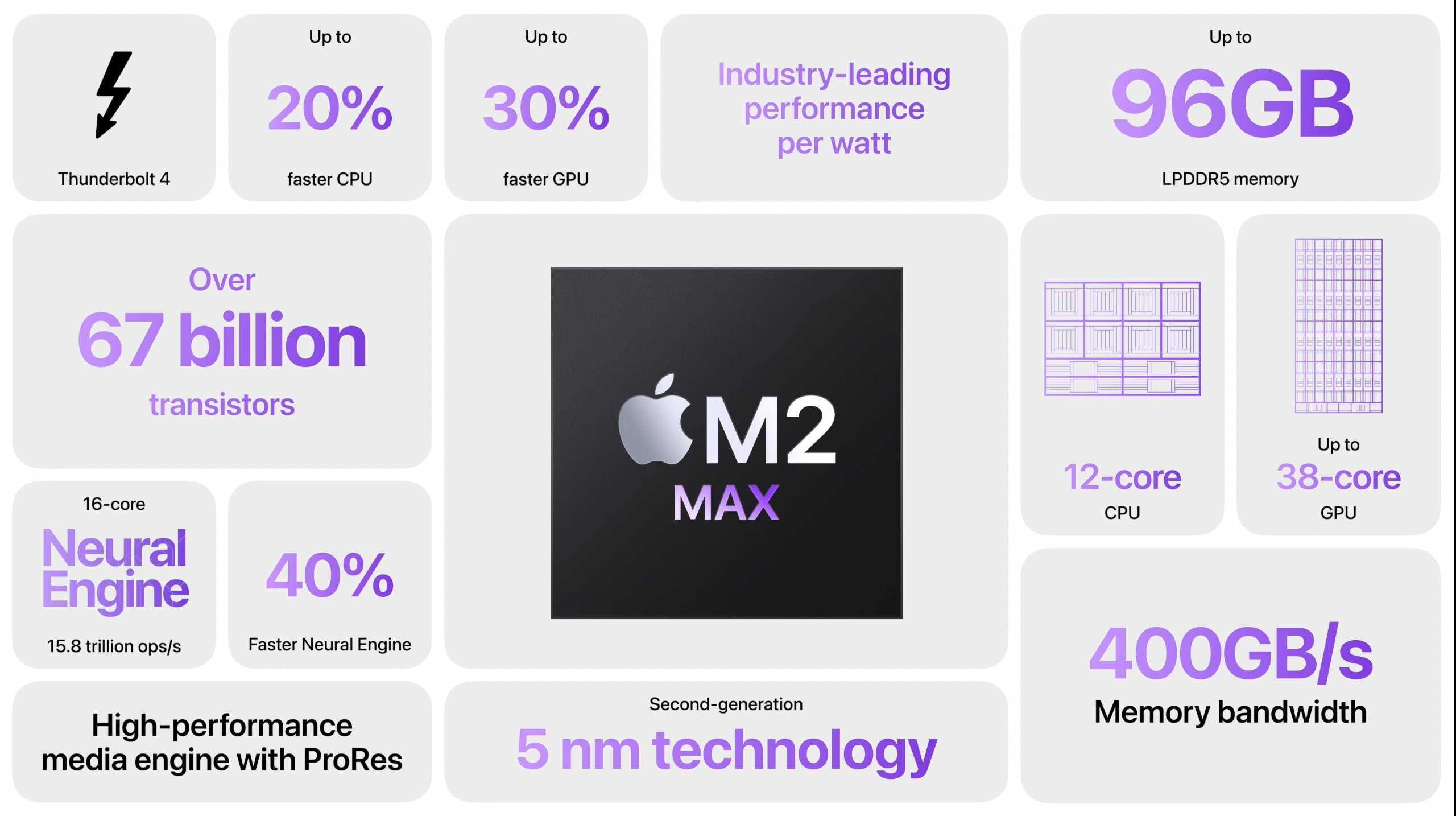
The M2 Max takes the M2 Pro and goes even further, with 67 billion transistors (10 million more than the M1 Max), additional CPU and GPU cores, and more memory bandwidth.
| M1 Max | M2 Max | |
|---|---|---|
| CPU cores | 10 (8 performance, 2 efficiency) | 12 (8 performance, 4 efficiency) |
| GPU cores | 24 or 32 | 30 or 38 |
| unified memory | 32 GB, 64 GB | 32 GB, 64 GB, 96 GB |
| Memory bandwidth | 400 Gbps | 400 Gbps |
| neural engine | 16 cores | 16 cores |
Apple claims the M2 Max is “the world’s most powerful and efficient chip for a business laptop.” It should be noted that it has the same multimedia engine as the M2 Pro, but only one video encoding engine and ProRes engines, where the M1 Max offered two of each. To upgrade to 96GB of memory, you’ll need a MacBook with a 38-core GPU, which costs $3,099 (14-inch) or $3,499 (16-inch), with an additional $800 upgrade. memory level on 32 GB.
In Apple’s benchmarks, the M2 Max touts a 30% improvement over the M1 Max using color grading in DaVinci Resolve; in the same test, the M2 Max is 2 times faster than the Intel Core i9 MacBook Pro. Rendering effects in Cinema 4D, the M2 Max is 30% faster than the M1 Max and 6x faster than the Core i9 MacBook Pro.


