
Expert rating
Benefits
- Blazing fast 6GB/s read, 5GB/s write via Thunderbolt 5
- Robust and weather resistant
- Beautiful design
- A bargain compared to Apple's internal SSD upgrades
Disadvantages
- Expensive compared to Thunderbolt 3/USB
- Requires Mac M4 Pro/Max for full 80Gbps performance
- Limited compatibility with older hardware and software.
Our Verdict
We like that OWC's new Envoy Ultra Thunderbolt 5 SSD is almost as fast as Apple's internal storage, but it's not cheap and backwards compatibility isn't comprehensive.
Price when reviewed
This value will display geotagged pricing text for the undefined product
Best price today
If you want to take full advantage of Thunderbolt 5 ports on your Mac mini M4 Pro or MacBook Pro M4 Pro/Max and possibly bypass Apple's stingy storage upgrade prices, you should consider the Envoy Ultra Thunderbolt 5 external SSD from Apple. OWC. The Envoy Ultra isn't cheap, but it's nowhere near what Apple charges.
On the other hand, there are more backwards compatibility issues than expected.

Thunderbolt 5 compatibility
While the speed is enticing, and Thunderbolt 5 itself East backwards compatible with older Thunderbolt specifications, it's not as backwards compatible as you might think, as we hope, or as is implied.
First, you need a Thunderbolt 5 compatible Mac or Windows PC to take full advantage of Thunderbolt 5's 80 Gbps transfer rates. 80 Gbps? Yes. Although you may have seen 120 GB/s cited in some articles as the maximum speed of Thunderbolt 5, this speed is only unidirectional for displays. Bidirectional, as for storage, is limited to 80 Gbit/s.
The first compatibility issue is that to use a Thunderbolt 5 drive, Apple Silicon Macs need either macOS 14 Sonoma or macOS 15 Sequoia. Thunderbolt 3 Macs with Intel chips should run Sequoia. Note that the Envoy Ultra did list on my Mac Studio Thunderbolt 4 bus when I was back on Ventura, but it was not available in Disk Utility or Finder.
Additionally, although the Envoy Ultra's captive cable prevents me from testing it on older Thunderbolt 1/2s using an adapter, the image above indicates that this is not an option. OWC has confirmed that Thunderbolt 5 won't work with older standards, so stick with Thunderbolt 3 hardware for older Macs.
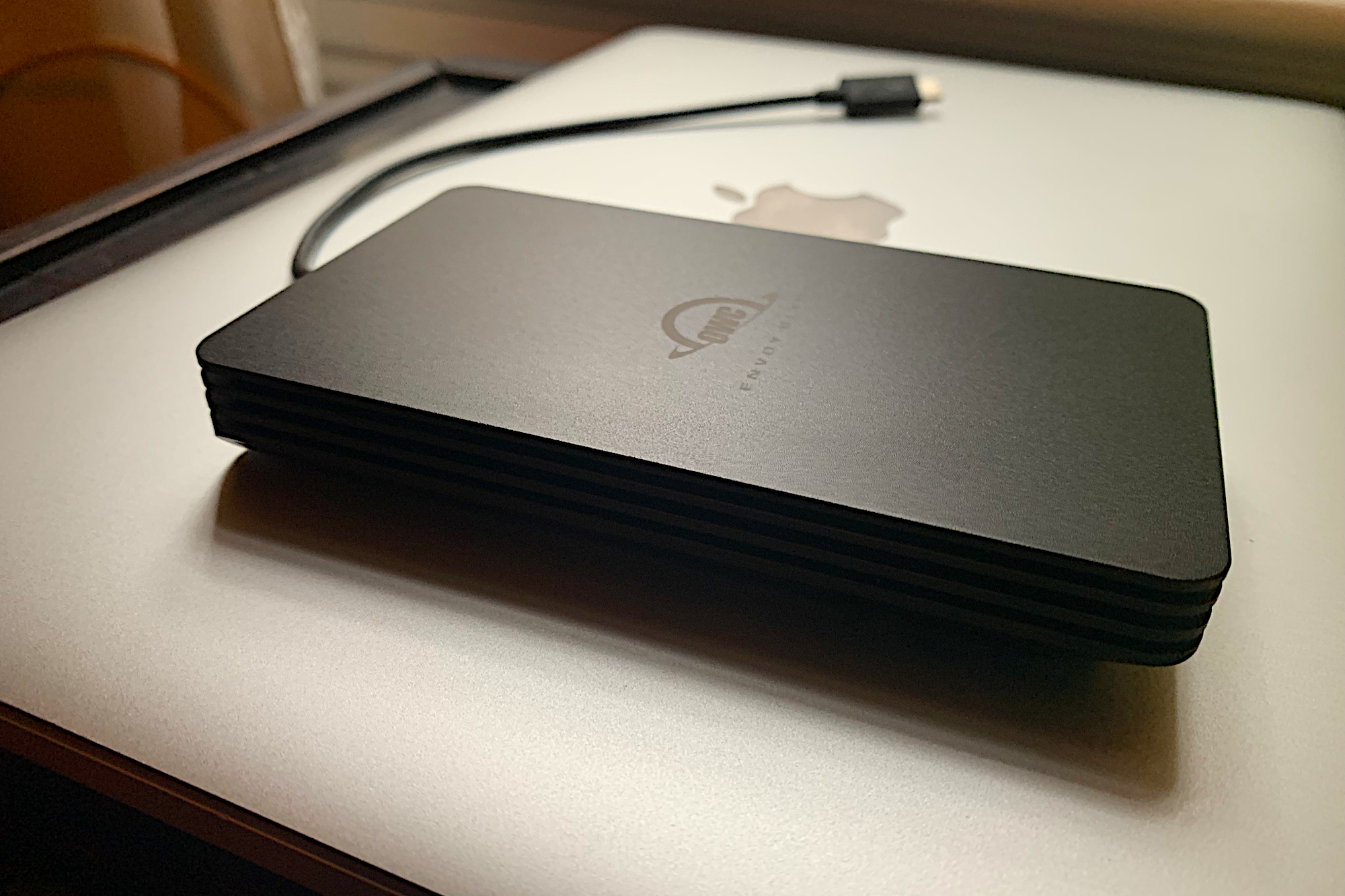
OWC Envoy Ultra Thunderbolt 5
SSD.
Jon L. Jacobi
Additionally, during my testing for PCWorld, there was a pretty significant problem with the official benchmark. This problem is that the Envoy Ultra completely failed to register in the BIOS, Disk Manager or Thunderbolt utility. Oops. This is despite updating all drivers, removing anything non-essential and even updating Windows 11 to the latest version on the test bench. Eventually, a BIOS/Thunderbolt firmware update from Asus fixed the issue.
This questionable backwards compatibility could be a problem if you are working in a mixed operating system environment. Some older equipment may not be updated.
Features
The OWC Envoy Ultra shares the sleek, sculpted styling of the Thunderbolt 3 40Gbps/USB 3.2 10Gbps Envoy Pro FX. However, it is a slightly larger piece of black metal, measuring approximately 0.75 inches thick, 2.8 inches wide, and 5 inches long. The Envoy Ultra weighs about 10.5 ounces, which is satisfying.

I've already mentioned the captive cable, which is for waterproofing (it's not IP rated, but it looks like it could pass testing) and to make sure you can't lose it. This does, however, make it a little more difficult to store the Envoy Ultra in tight spaces. Additionally, as with all captive cables, you should avoid stressing the attachment point for longevity reasons.
The OWC Envoy Ultra comes with a three-year warranty, but no TBW (Terabytes Writeable) rating has been assigned.
Price
If you thought a Thunderbolt 5 SSD was going to be cheap… well, I have some cool real estate that might interest you. The Envoy Ultra costs $400 in 2TB form and $600 at 4TB.
Considering you can get a Thunderbolt 3/USB4 SSD for about half that price and a 20/10 Gbps unit for well under half that, you better really need or want the speed. Note, however, that despite a new 20Gbps 3.2×2 tunneling protocol that can work with docks, 3.2×2 SSDs still drop to 10Gbps when connected directly to a Thunderbolt 5 port. 20Gbps USB4 SSDs will run at full speed connected to Thunderbolt 5.
Then again, compared to Apple's exorbitant prices for internal storage upgrades ($1,200 for 4TB???), the Envoy Ultra is a steal.
Performance
Short answer: very quick. Benchmarks showed between 5.2 GB/s (Blackmagicdesign disk speed test), 6.5 GB/s read (AmorphousDiskMark), up to almost 7 GB/s read and 5.57 GB/s in writing (ATTO). Even my actual playback of around 330GB of .mov files showed an excellent turn of form – almost 6GB/s reading. Alas, writing was considerably slower, only around 1.5 GB/s.
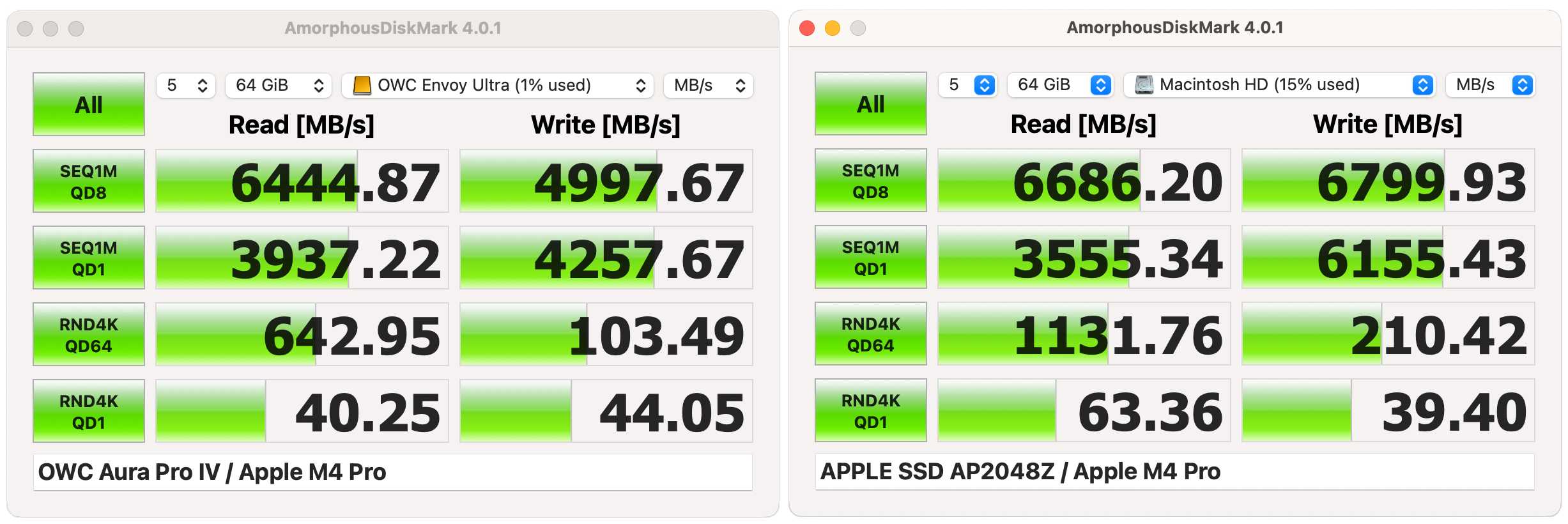
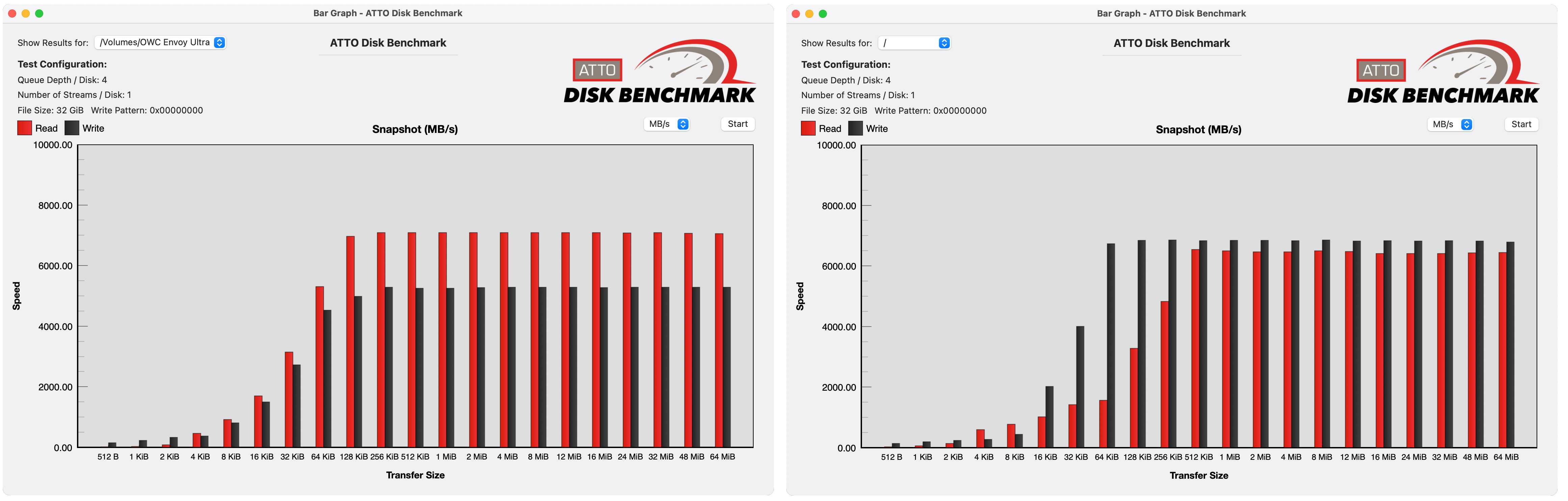
Note: I copied to and from the same MacBook Pro M4 Pro (2TB) that I ran the synthetic tests on. For comparison's sake, and to enlighten those who might be looking to avoid paying ridiculous amounts for Apple's internal storage, I've included benchmark results from the MacBook's internal SSD. These are shown to the right of the OWC Envoy Ultra in the images below.
The difference between internal and external storage is not as severe as one might expect. Long story short, the read results were mostly remarkably close, although the internal SSD was much faster at writes in almost all circumstances.
Note that the fastest external SSD we've previously tested, the USB4 Adata SE920, only barely exceeds 3 GB/s read speeds. Yes… Very quickly.

AmorphousDiskMark showed better numbers for Envoy Ultra reading – a rather scintillating 6.44 GB/s. Not that far from the internal SSD of the MacBook Pro M4 Pro. Around 5 GB/s writes from the Envoy Ultra seems to be the consensus from all three synthetic benchmarks.
ATTO Disk Benchmark paints largely the same picture, although the Envoy Ultra's read speeds actually exceed those of the MacBook Pro M4 Pro's internal SSD. Writing? No, although around 5 GB/s isn't really anything to sneeze at.
Even though our actual file writes didn't meet the benchmarks, they were still pretty good. All in all, the OWC Envoy Ultra is a very nice upgrade in performance over the average Thunderbolt 3 SSD and a worthy companion for any Thunderbolt 5 Mac.
Note that the SSD inside the Envoy Ultra is the Auro Pro IV. You can read more about its performance (good then, not so much now) in sister publication PCWorld's review. That said, the Envoy Ultra, when running on our updated benchmark, posted a very, very slow write time of 450GB.
Should you buy the OWC Envoy Ultra?
If you want it and can afford the fastest storage for your new Thunderbolt 5 Mac, then the answer is yes. Go for it. Plus, it's much cheaper than Apple's highly priced internal storage, and almost as fast. That said, Thunderbolt 3/USB4 SSDs are still very fast, cheaper, and much more compatible with older Mac hardware and software. I'll let you decide the value equation.
Table of Contents


