
In many ways, the Apple C1 – its first cellular modem – has been the most important product of the company for years. Just as the company has freed itself from intel dependence with its own Mac processors, it is now free from dependence on Qualcomm for cellular connectivity. The abandonment of Broadcom for its own Wi-Fi and Bluetooth would also occur this year.
But the chip was published in Little Fanfare, with the almost buried announcement in the details of the iPhone 16th. After testing the modem, we know why: it is good enough for Apple's iPhone 16th “budgetary”, but only fair.
We transported the iPhone 16 and the iPhone 16th everywhere in Sacramento, California, performing several speed tests to compare Apple's Modem against Qualcomm. The results are clear: Apple cannot follow, at least not yet. But the speed is not all that matters for a cellular modem.
Apple C1 modem: how we tested
To carefully test a cellular modem, you must take thousands of measures worldwide, when connected to various networks under different conditions, in addition to the controlled laboratory conditions. We can't do all of this, but we can Schlep around an iPhone 16 and iPhone 16th, taking several measures in several places, until we obtain enough data to train certain conclusions.
We used the popular Ookla Speedtest application to test network performance. Since the performance is so variable, we have taken three measures at each location on each phone, one after the other, and made the average results.
Our tests were carried out on the Verizon network in several places in the Sacramento region, California, mainly in the afternoon per day with good weather. We tested inside and outside, in a mixture of difficult areas, as in a grocery store or the changing rooms of a gymnasium, and easy and efficient areas such as outside the Golden 1 Center when there was no major event.
The C1 does not support MMwave, so we do not expect multi-guigabit speeds, but even more important than occasional Wi-Fi speeds is the functionality of functionality in areas where the connection is low or saturated. Let's see how the C1 resists.
Apple C1 modem: downloads and downloads
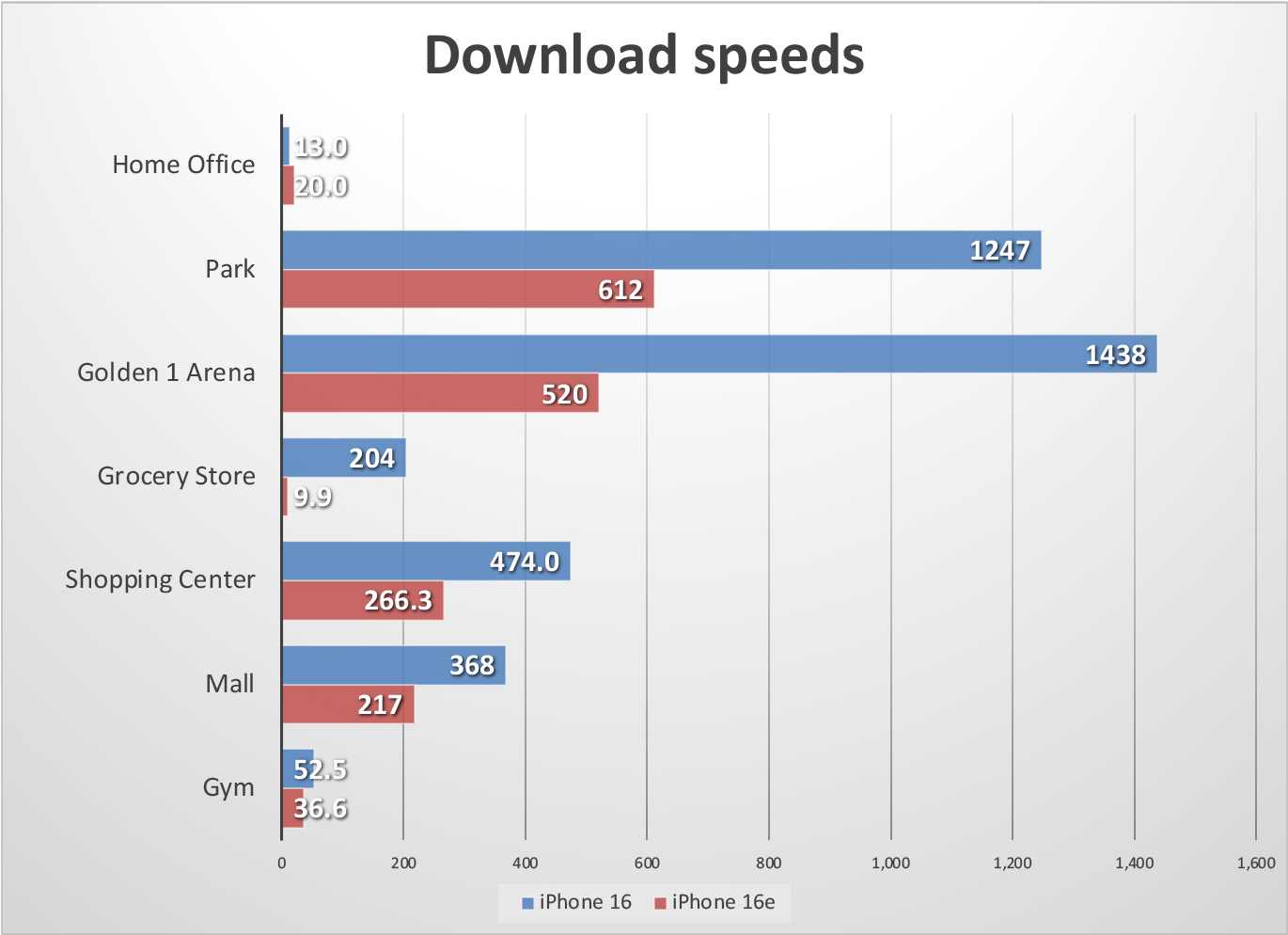
With the exception of the test in my home office (which has poor connectivity with mobile networks), the Qualcomm X71M of the iPhone 16 ran to Apple C1 at each location. In the supermarket where it is difficult to obtain a very good connection, the C1 has bombed hard, by downloading only around 10 megabits / s while the Qualcomm Modem has managed more than 200. Do not forget that it is the average of three successive tests, to reduce the natural variability of cellular performance.
It is possible that the iPhone 16th could not be locking on a signal on a strip that works better there, but whatever the reason, thanks to several tests, we simply could not get a good connection.
Foundry
In the park or Golden 1 in the center where the iPhone 16 exceeds a gigabit of download speed, we are not very concerned about the Apple C1 managing half of the performance. Once you can download several hundred megabits per second, you will not have a very different experience in progress faster, not on your smartphone.
The download performance was much closer, with Apple C1 trading wins with the Snapdragon X71M.

Foundry
If there is a problem, it is with the tests carried out inside the gymnasium or the nearby shopping center, where the Qualcomm modem was several times faster than Apple. The gymnasium in particular is a very difficult area; It is inside in a large building full of equipment where connectivity is uneven, and dozens of people are all on their phone both during their training. We couldn't even get a half-megabit of iPhone 16th download performance there.
Apple C1 modem: overall performance
By taking the speeds of each location and making them on average, we start to see a general general image of the way in which the Apple C1 modem of the iPhone 16th compares to the Qualcomm Snapdragon X71m in the iPhone 16.

Foundry
You can say that, at least in our tests in various places, the Apple C1 offers roughly the same overall download speed as the Qualcomm Snapdragon X71m but about half of the download performance.
Again, it all depends strongly on the location and the conditions, but it was coherent enough to show a clear scheme.
Apple C1 modem: efficiency and reliability
Of course, download and download speeds are only part of the image with regard to cell performance. It is just as important that you do not exceed the calls and that this very swallowed component of power does not drain your battery too quickly.
We made several punctual calls during the tests using the two phones and noticed any significant difference in the quality of the calls. No call has ever dropped on one or the other phone. Hundreds of calls would need in many places, all due to ten minutes or more, to obtain a really clear image of knowing if a modem drops the calls more than the other, so consider our anecdotal tests at best.
Energy efficiency tests also require specialized equipment to isolate the power draw of the modem alone and measure it with different signal forces. This is exactly what Geekerwan Geekerwan has done, and they have found that in fact, under ideal conditions, the Apple C1 uses approximately 25% less power than the Snapdragon X71M in the iPhone 16, but that power savings become smaller if the signal is low.
We are talking about a difference from a fifth of Watt, which can be added over time, but it is not really a huge contributor to the overall battery life. The iPhone 16th has a larger capacity battery than any 6.1 inch iPhone before; It contains approximately 12% more load than the battery of the iPhone 16, and this seems to be the largest factor in the long life of the iPhone 16th battery.
The C1 is not good enough for flagship iPhones … Yet
The iPhone 16th is Apple's “more affordable” iPhone, although $ 600 or more, it could hardly be considered a budgetary smartphone. It makes several dealerships to shave $ 200 of reduction on the price, and we can consider cellular performance as one of them.
Making a competitive 5G modem is a Herculean task, which was out of the range of Intel (and therefore why the company sold all its modem division to Apple). There is a reason why Apple is late to put a modem on the market. The fact that it works and seems to work very well without any obvious massive defect is a whole feat in itself.
But he cannot follow Snapdragon X71M of Qualcomm in the iPhone 16, and it is not even the best Modem of Qualcomm, which would be the Snapdragon X80. It is not even the X75, which was found in many phones last year. It seems that it is a kind of custom variant on the X70, although the details are rare.
The Apple C1 is good enough for the cheaper model of the company, but if you spend $ 800 + on the latest iPhone, or $ 1,000 + on an iPhone Pro, you expect better than “good enough”. Without obvious evidence that it considerably improves the battery life, which we do not see, it would be a huge disappointment to find the C1 in the iPhone 17 this fall. Fortunately, rumors claim that Apple will indeed remain with Qualcomm for at least another generation.
But Apple says it is the first modem of many. The company already has C2 and C3 modems in the pipeline (it should be done, considering the process of development and multi -year test). These are supposed to get closer to the performance of the best Qualcomm modems while improving energy efficiency and offering narrower integration with other Apple silicon. The C1 is an excellent start, but Apple still has a long way to go.
Table of Contents


