
A distinctive feature of Apple’s “mixed reality headset with video relay” is the external display. When in use, it displays swirls of light, but the main feature is something Apple calls EyeSight, which offers others a way to connect with you by seeing your eyes, so you don’t seem isolated from the rest of the world. when you wear your helmet.
With its powerful relay, Apple Vision Pro helps you stay connected to those around you. EyeSight reveals your eyes and notifies people nearby when you’re using apps or are fully immersed in an experience. When someone approaches, Apple Vision Pro lets you simultaneously see the person and reveal your eyes to them.
There’s just one problem. This doesn’t work well at all. The lenticular lenses supposed to provide 3D viewing angle effect create a narrow field of view, the bright outer class covers everything in glare, the brightness is too low and no matter what is on the screen, it seems like others can’t really. say whether you can see them or not.
This was a technological solution to the dissociation of wearing a headset from others, but in practice, it is the “blue glow” that makes Apple’s headset different from others. It’s about as useful as the glowing blue ball of light on the top of a HomePod (where you can’t really see it unless you’re on top of the thing anyway). This adds complexity and expense with little benefit beyond what a small, bright LED would provide.
The idea behind EyeSight
The idea is quite simple. When you wear a VR headset, half of your face is hidden. Even though the headset transmits video so you can see the outside world, not everyone knows whether you can see them or not.
So Apple installed a screen on the outside that shows your eyes (or rather a digital reconstruction of them, similar to the Persona feature) whenever you can see them. The eyes are animated, rotating and blinking when your real eyes are, thanks to eye-tracking sensors inside. When you’re in a “fully immersive” (totally VR) experience, the screen displays a cloudy blue/purple glow.
As people approach you, they can sort of disappear through your immersive experience or the floating windows you have placed, depending on your settings, and your eyes will sort of disappear through the glow. Apple even went so far as to use a lenticular lens in front of the EyeSight display, so that it shows your eyes from different angles depending on the viewer’s angle.
It’s a good idea, and until we have true transparent displays that can render ultra-sharp graphics on them with the ability to black out light if necessary, something like EyeSight is probably the only way for people outside to “see” you in the headset.
If only it worked, you know.
Foundry
It just doesn’t work
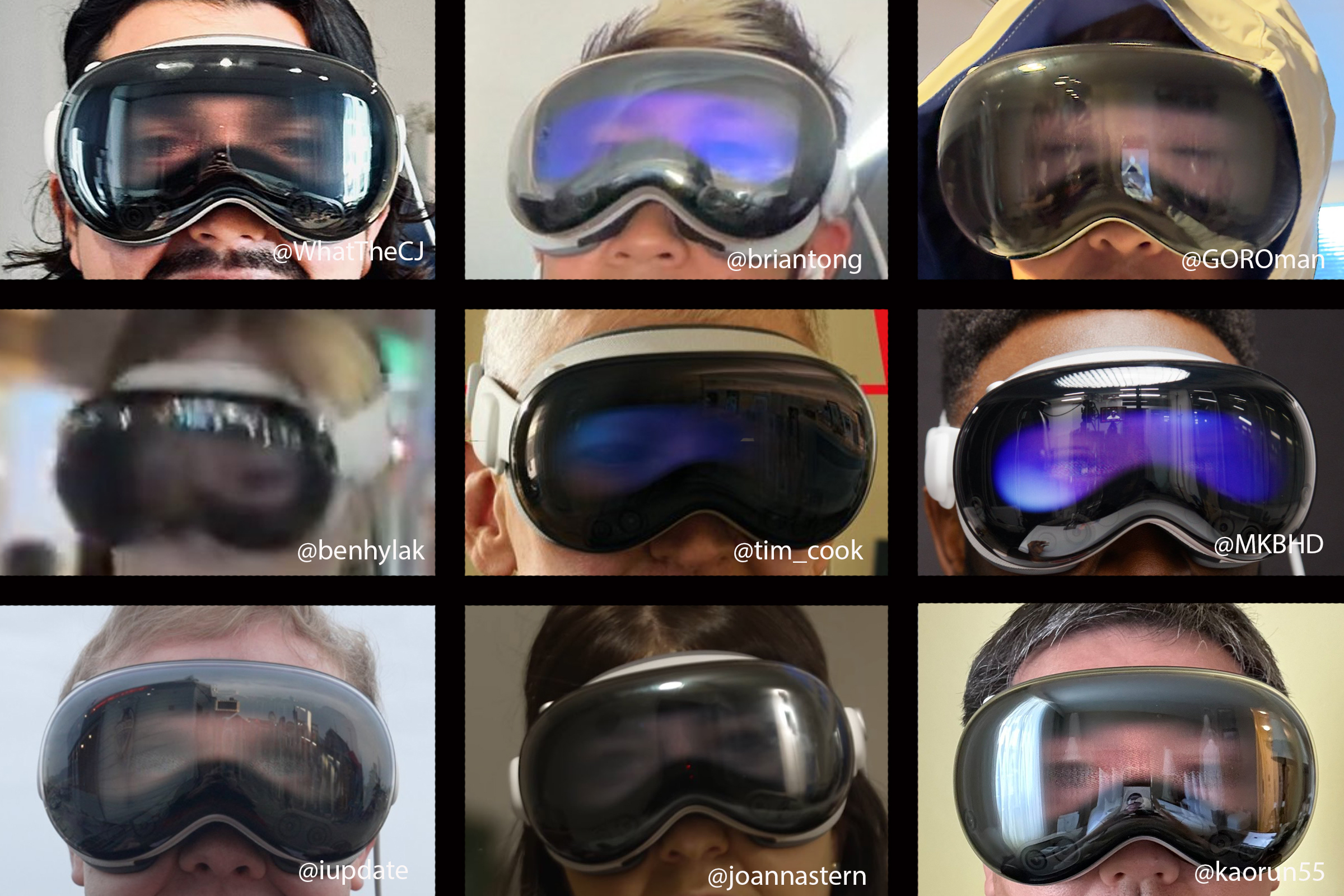
The EyeSight display simply has too many problems. The rendering to your eyes is low-resolution and blurry, partly due to the quality of the front display and partly to the lenticular lens effect. The actual rendering is distorted and therefore appears “correct” through the lenticular film.
The screen itself is a relatively narrow strip, not even half the size of the full front of the headset. It’s not very bright, even before coatings and coatings reduce the brightness further. Then there’s the headset itself, which is so incredibly shiny that you see shiny highlights everywhere in almost any lighting. If you want to actually see someone’s eyes clearly, the room needs to be fairly dimly lit, in which case the passthrough video becomes a grainy mess.
The image at the top of this article compares Apple’s promotion of the feature to the best possible view I was able to capture, after several attempts. It’s bright, blurry, misaligned (my eyebrows are often the center of attention) and in no way suited to making that “human connection.” View, to his favorite, does not facilitate connection with the people around you. For everyone else, you’re still “in VR” and they don’t know where you’re looking or what you’re doing. Most of the time, others just see an ethereal bluish glow, no matter what you seem to be doing inside.
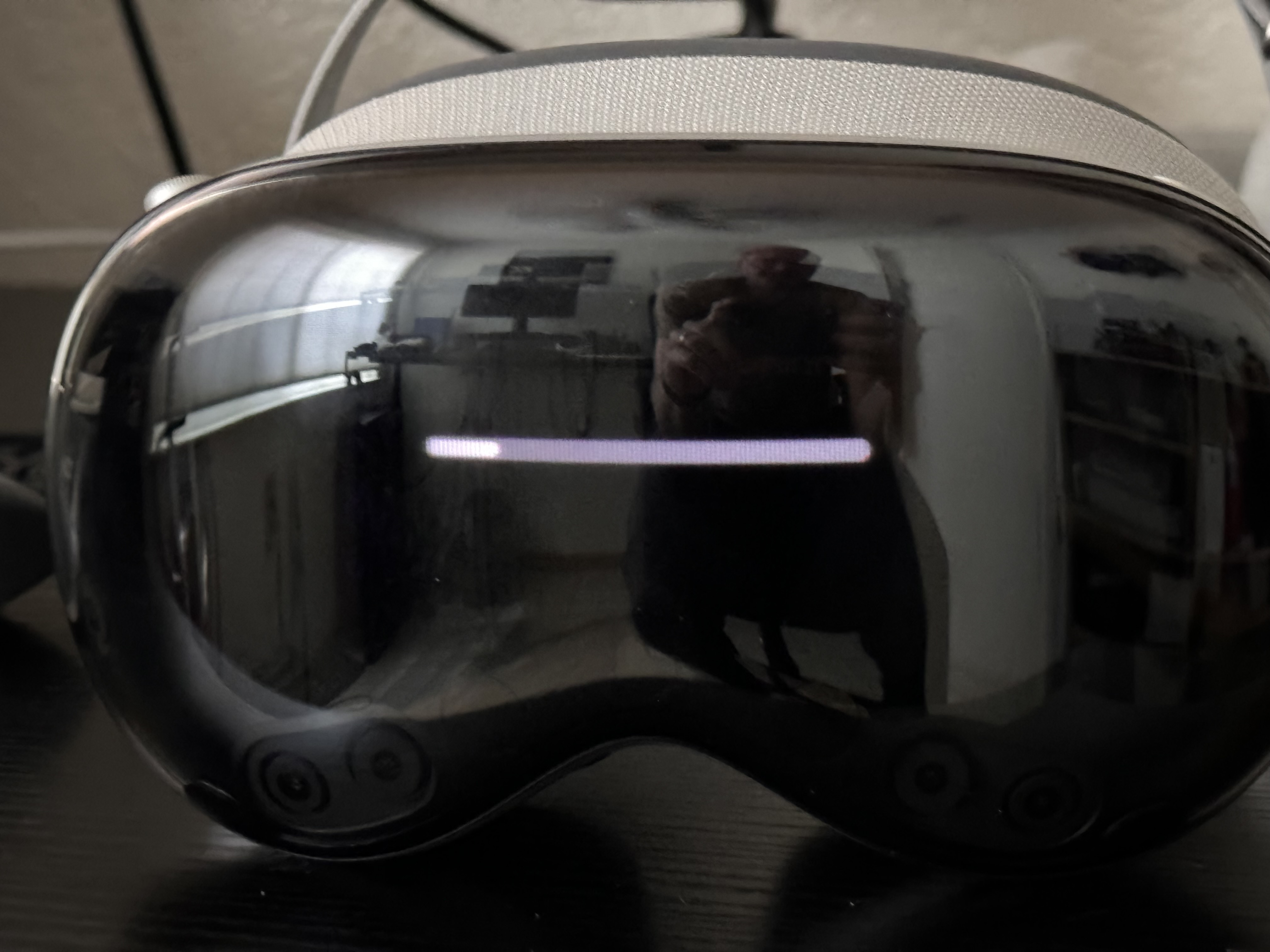
The best use of EyeSight seems to be to provide general information, like the progress bar that appears when you install a software update.
Foundry
EyeSight in the future
The EyeSight concept is solid, but it will take several software updates to get it to work properly. New equipment will be needed.
Given that this first product is called Apple Vision Pro, it’s reasonable to expect that future models will be available in both “Pro” and “non-Pro” variants. I would bet that Apple will double EyeSight for the Pro version and eliminate it on the non-Pro model to reduce costs.
After all, EyeSight does few things today that wouldn’t be communicated as effectively with a simple multi-color LED: a green light might mean the user can see you, an orange light means they can’t see you, and a red light could mean the user can see you. means the headset is recording.
For EyeSight to really work in a future model, it needs to be physically larger, covering more of the occluded part of your face. Brightness needs to be much better, as well as an anti-glare plastic coating on the outside of the Vision Pro glass. That might make the “eyes” part work, but Apple could probably make the screen do more to convey other useful information. The current “recording” animation isn’t intuitive for most people – the universally recognized designation for a recording camera is a red light, Apple should lean into it with a clear flashing red dot. A quick press of the top button when the Vision Pro is not worn can briefly display the battery charge status on the EyeSight display. Perhaps an external icon could let viewers know if a user can’t hear you (wearing headphones that aren’t in transparency mode).
Some of this could be accomplished with software updates today, which would at least give EyeSight one more reason to exist.


