
On one occasion, when calling customer service, you heard a voiceover warning you that the call may be recorded. In accordance with this, It's normal to wonder If between individuals it is possible to make a recording of the call. Well, for technical reasons, yes. Legally, there are already more conditions.
It is possible to record calls on Android phones, although ultimately it all depends on the legality of the country you are in. Regarding Europe, This is regulated by the criminal code in a section in which, in addition to calls, it also refers to other communications established, among others, with cell phones.
Problematic recordings are those in which you do not participate
As we said in the introduction, the recording of calls is provided for by Spanish law and more specifically by article 197.1 of the Penal Code. In this section we talk about crimes of discovery and revelation of secretssomething where this type of recording comes into play.
Of course, what is typical is appropriate and/or expose the communications of others without their consent. The paragraph literally says the following:
“Whoever, to discover the secrets or violate the privacy of another, without their consent, seizes their papers, letters, emails or any other documents or personal effects or intercept your telecommunications or use technical devices to listen to, transmit, record or reproduce sound or image, or any other communications signal“.
Recording the calls of others without consent is a crime, whether the purpose is lawful or not (unless authorized by a judge).
This involves intercepting communications in which we are not actively participating. That is, through any dedicated application or system we proceed to record other people's conversations. In these cases, the executioner would be confronted prison sentences ranging from one to four years and fines ranging from 12 to 24 months. And this in the best case scenario, since the penalties would amount to prison sentences of two to five years if these recordings were also “disseminated, revealed or transferred to third parties”.
Yes, there is some permission in these facts to intercept other people's calls without needing their consent and that's it allowed by a judge as evidence of a possible crime that can be used in a trial. However, this is a task that ultimately falls more to the police force, given that it is not common for a judge to grant this authorization to an individual.

Therefore, the main thing in this regard is that you will need to ask permission from both parties and obtain their full consent. If you don't have this, it will be illegal even if the reason you intercepted the conversation is legal as evidence in a lawsuit or similar.
Recording calls you participate in doesn't even require consent
You will have noticed that in the previous section we refer to calls in which we do not participate, regardless of how we intercept them. Well, then, in the event that we participate in the callthings change a lot.
In these cases no crime is contemplated in the recording and the sanctions explained above have no value because in this case a crime is not constituted by the act itself and regardless of whether you have previously notified and how you save these recordings.
The problem comes from the distribution of these recordings without authorization of the participant(s) in the conversation. In this case it is equal to the previous case and it is a crime of revealing secrets which, as we said previously, can result in sentences of two to five years in prison. All
Summary: You can record calls you participate in, but not expose them without permission. Likewise, and reviewing what was mentioned in the previous point, recording calls in which you are not an active party is in any case a crime if you do not have the authorization of the parties.
The recordings we participate in are admissible in court, but they must not be manipulated and must provide sufficient context.
Concerning use these recordings in legal proceedingsto say that they are admitted as evidence, even if logically they should not be manipulated, but rather integrated and with sufficient context of the situation being judged for the judge to admit it.
Indeed, we find certain judgments of the Constitutional Court such as STC 114/1984 of November 29, which literally says that “anyone who uses a device during their conversation which allows them to copy this conversation, does not violate the confidentiality of communications“. He adds exceptionally that this recording does not take place in an intimate setting, but another subsequent judgment expressly indicates that a telephone recording, since one of the interlocutors is the one recording, does not correspond to this intimate area.
Android doesn't allow this natively and is already very strict with third-party apps
Just a few months ago we were already examining in Xataka Android Google's position regarding call recording in its mobile operating system. The idea that remains is that they don't want Android to use these features So we saw how they gradually became stricter and stricter.
Natively, there has never been a feature to allow or not record calls, at least in a simple way. However, there was a certain open bar for developers to publish their apps dedicated to this on Google Play. Of course, you still need to have Android accessibility permissions to be able to do this.
Google doesn't allow call recording apps in its store, but they still exist (they're also in APK stores on the internet)
A year and a half ago, in May 2022, Google got even more serious and released a ban on publishing apps that use accessibility services to record calls. This means that many well-known apps for this function have left the Google store.
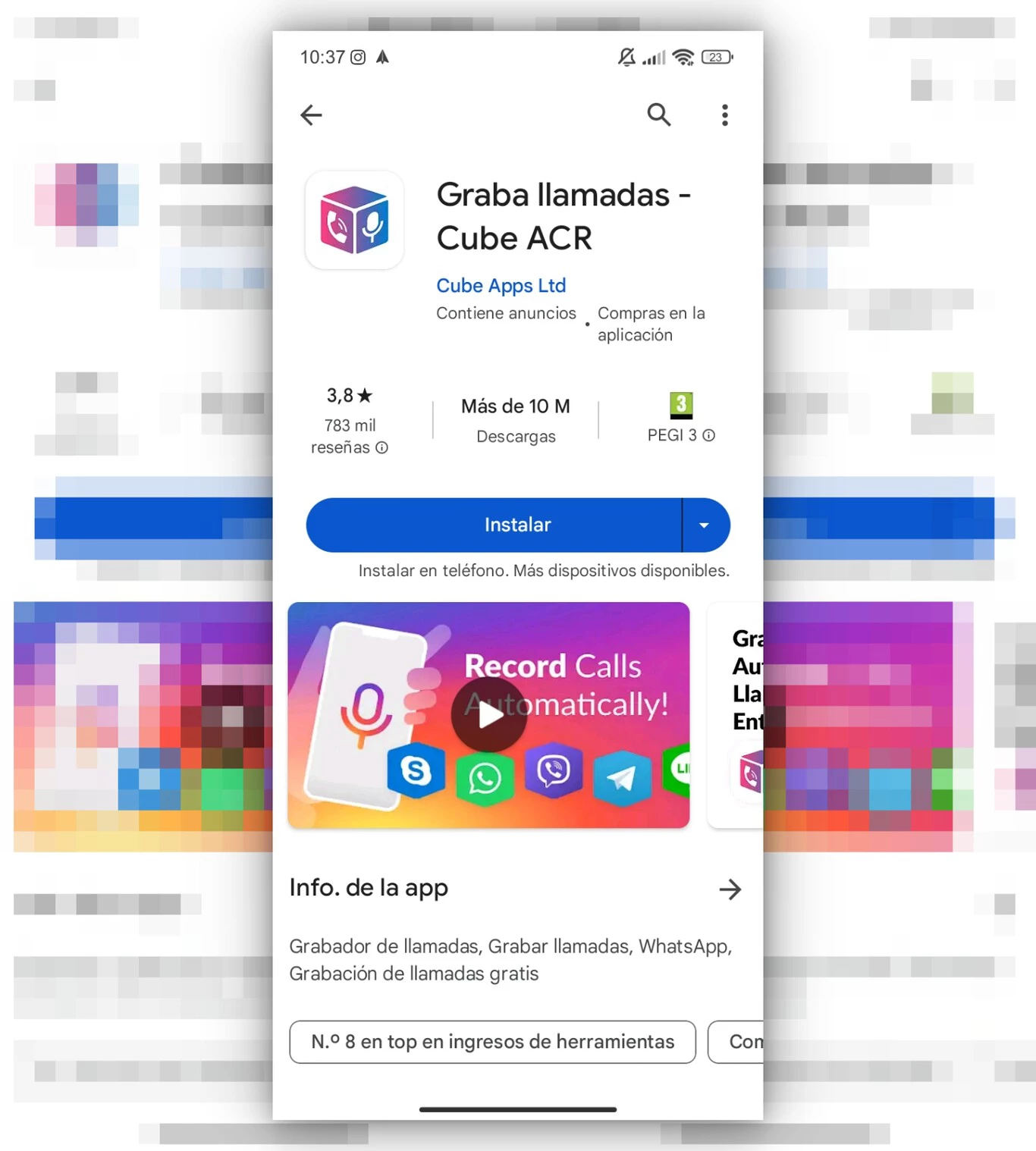
Example app that records calls and is still on Google Play, although it now focuses more on recording calls on WhatsApp, Telegram, Skype and other messaging apps
Of course, as contradictory as it may seem, We continue to find apps that violate this rule. And we are not only talking about those that can be downloaded through APKs on the Internet, but in the Google Play Store itself there are still examples of applications that are not only advertised with the aim of recording calls , but which also function as such when downloaded. .
So, according to what was previously commented on legality, You can use these apps to record calls you participate in provided that you do not use them subsequently to expose them publicly or to a third party. Basically, no matter how hard Google tries to block these apps, it doesn't have the power to block third-party APKs. And that is if you download them from outside, because if you resort to those from Google Play, the problem is that Google itself continues to authorize them and not yours to download them (although perhaps a day they will disappear and remain without updating). support via Google Play).
By | Dexia Lawyers | CAD Services
In Xataka Android | How to solve WiFi connection problems on Android mobile


