
In this series, we remember the motives of the past that caught our attention out of the ordinary. After having told you about the Samsung Continuum, LG G DoublePlay, Samsung Galaxy Beam, Sony Xperia Play and others, today it is the turn of the Motorola Backflip, with QWERTY keyboard and touchpad.
The Motorola Backflip is an early Android terminal – it’s Motorola’s third model – when it was still relatively common to include a QWERTY keyboard. What escaped the usual was the mechanism to unfold the keyboard.
Motorola Backflip technical specifications
|
Motorola Backflip |
|
|---|---|
|
Filter |
3.1 “TFT |
|
Dimensions and weight |
108x53x15.3 mm |
|
Processor |
Qualcomm MSM7201A |
|
RAM |
256 MB |
|
Storage room |
512 MB |
|
Front camera |
No |
|
Rear camera |
5 MP |
|
Drums |
1,400 mAh |
|
Operating system |
Android 1.5 |
|
Connectivity |
3G |
|
Others |
QWERTY keyboard |
|
Starting price |
100 dollars |
The Motorola Backflip’s specs are almost laughable today, although it must be remembered that it has been over a decade since its launch. Specifications weren’t a big deal Nor for the time, because it was not the power supply that was wanted in the terminal, but this “gimmick” of the keyboard.
To give us an idea, your MSM7201A processor has a lithograph of 65 nanometers and a single core at 528 MHz maximum clock speed. All with 256 MB of RAM and only 512 MB of storage: these are not unknown figures for the time, but they are not the most cutting-edge on the market either. In the same year, the Samsung Galaxy S and Samsung Google Nexus S were released, both with a 1 GHz processor and up to 16 GB of storage.
The Motorola Backflip specs were fair enough even for the time, with 512MB of storage and a 528MHz processor.
Part of the blame for these moderate specs lies in the size of the Motorola Backflip, which is a very small terminal, but energetic. With a 3.1-inch screen and a size of 108 x 53 millimeters, it was a bit larger than the Sony Xperia Mini Pro (92 x 53 x 18 mm) and a bit thinner. Despite everything, they are 15.3 millimeters thick, more or less double the current mobiles.

The Motorola Backflip did not have a front camera, which was normal for the time. However, in this case, there is a good reason for this, because the rear camera could be used to take selfies if the keyboard is displayed. Of course, that would be in a somewhat odd position: in the lower corner, like in the original Xiaomi Mi Mix.
As for the battery, the Motorola Backflip included a 1400mAh battery which, of course, could be removed. A curious fact about the Motorola Backflip is that it is included a touchpad behind the screen for some reason. All this with Android 1.5 and the promise of updating to Android 2.1.
What was its particularity?
The Motorola Backflip was one of the first Android phones released by the company. Back then, cell phones with QWERTY keypads were still very much alive. The novelty of the Motorola Backflip, and the reason for its name, is the way the keyboard is displayed, which is not slippery as usual.

In the Motorola Backflip, the company reverts to place the keyboard on the back, a further rotation. I mean, it’s technically like a laptop that can be folded up completely to put the keyboard on the back.

The unfolded Motorola BackFlip looks like a typical QWERTY mobile keyboard, but the difference is in the mechanism
At first glance this may seem like an unnecessary complication compared to other more direct mechanisms like the slider, or an “inward” rotation that puts the screen and keyboard face to face when it is closed, although this mechanism had its advantages.
The way the keyboard was rotated had the advantage of being able to use the camera to take selfies as well.
The main thing is power reuse the camera to take photos and selfies. With the “compacted” mobile, the keyboard stays behind the terminal and, therefore, can be used to take pictures normally. By folding out the keyboard, the camera is pointed straight ahead and can therefore be used to take pictures of yourself or in video conferencing applications.
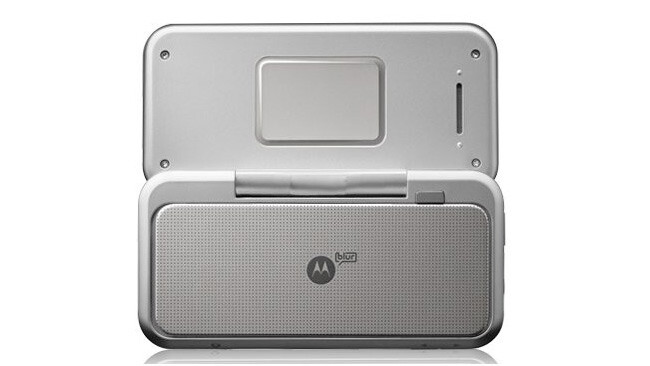
From behind, the Motorola Backflip had a small touchpad (above)
To make it all possible, the Motorola Backflip it included the only camera and the flash on the keyboard, in the lower left corner. An ingenious solution, but with the side effect of smearing the lens when using the keyboard is normal. The keypad includes keys for navigating the system, eliminating the need to touch the screen more than necessary.
As if that weren’t enough, there is a small touchpad behind the screen, which you can use to browse through the different photos in your gallery without touching the phone screen. With a touchscreen and a keyboard that also has arrow keys and must be unfolded to access the touchpad, it seems totally unnecessary, but the truth is, Motorola has included a similar touchpad in several models.
Is there such a thing today?
The Motorola Backflip was born in the early days of Android and today, over a decade later, the landscape has changed radically. For better or for worse, it’s very difficult to find a mobile with a physical QWERTY keyboard. What is coming back with the rise of folding and an Android system that is increasingly better prepared for all types of devices are the new form factors.
The Motorola Backflip broke new ground with a new way to include the keyboard and reuse the camera and today we have similar situations with foldable mobiles or with two screens, like Microsoft’s Surface Duo. Also with hinge, but for two screens instead of one screen and a QWERTY keyboard.

The Motorola Backflip could be the great-great-grandfather of the Surface Duo
Another particularity of the Motorola Backflip is that its hinge allowed keep him standing alone, either with the keyboard below (“laptop” mode) or by forming an inverted V. Until a few years ago, this was still quite unusual without the help of at least one special case for mobile.
Motorola Backflip spirit lives on in foldable phones today
Then came the Samsung Galaxy Flip, with a foldable screen that can be adjusted to different angles, including right angles. Applications adapt to this format and one of these means of adaptation is precisely that the keyboard is displayed at the bottom and the content at the top. A similar concept that of the Motorola Backflip.

The Motorola Backflip stood on its own
There is no articulated mobile to unfold the QWERTY keyboard these days, but the idea of transform the experience of using a device it is still very much alive, represented mainly by folding mobiles and the occasional experiment with double screens and hinges.
Android started off as the Wild West with all kinds of weird experiences and then evolved into a boring homogeneity where all mobiles are more or less the same. Ten years later, the experiences cautiously return, and it seems to stay.


