
If you have already wondered why Apple products are so pleasant to touch and seeThe answer is hidden in a mathematical equation 150 years ago. Cotoid or Euler spiral is the geometric key which makes Cupertino devices of objects of desire. A perfect curve that connects the world of mathematics with contemporary industrial design.
From subtle curves of the iPhone to the perfect transition between the screen and the body of a MacBook Air. From the ergonomic shape of the AirPods to the sweet curvature of the Apple Watch cover. All these apparently different products, They share a common geometric DNA: This mathematically perfect curve which means that each surface flows naturally towards the following. Even in the software, we see it. It is not an accident that when setting up an iPhone next to an iPad, a Mac or even the Apple TV remote control, they seem to belong to the same family. It is the cootoid that unites them.
Hidden geometry after tactile seduction: what is a cootoid
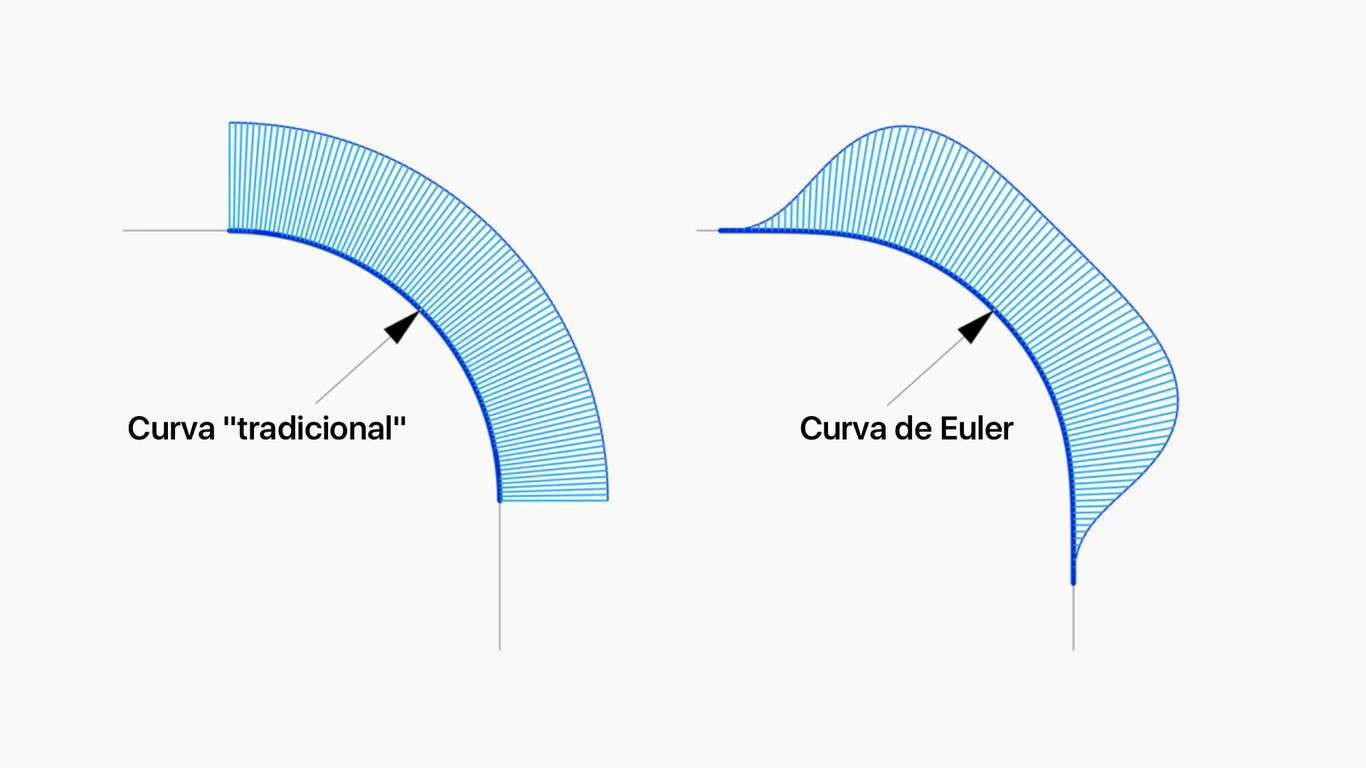
The Cotoid, also known as Spiral euler the spiral of cornIt is a mathematical curve with a property: its curvature changes in proportion to the distance traveled. In simple terms, it starts almost as A straight line and gradually curvedWithout sudden jumps or interruptions.
Its parametric equation is relatively complex and implies integrated calls for Fresnel. But his beauty lies precisely on the way he transforms abstract mathematical concepts into pleasant physical sensations when we interact with objects that incorporate him. The property that makes this curve unique How the problem of transitions solves: How to go from a straight line to a curve, or from a flat surface to a rounded, so that the pleasant change for our senses?

From the railway to Cupertino: the surprising story of a centenary curve
The most curious thing about the Cotoid is that its first mass use had nothing to do with smartphones or computers. This curve was initially developed by the Swiss mathematician Leonhard Euler in 1744But this has become a practical relevance thanks to the French physicist Marie Alfred Cornu in 1874, who studied her in depth.
The first large application on a cotoid scale was in the design of railways. The 19th century rail engineers discovered that, when using this curve to design the transitions between straight and curved sections, trains could maintain higher speeds Without generating sudden side forces This will bother the passengers or destabilize the road. We see this sweet curve in many more places than we believe.

- Road design: to soften curves and improve road safety
- Typography: create more harmonious and legible characters
- Architecture: resolve the transitions between the structural elements
- Optics: in the design of the lens and the mirrors
- Aerodynamics: Optimization of wings and fuselage profiles
The Jony IVE and Apple design team did not invent the Cotoid, but They were pioneers to apply it to the design of electronic devices. If you look, the first Mac before Jonathan Ive arrived had more square shapes. And that's something we can also see today between the Android and iOS smartphone.
Mathematics that seduce: why our brain goes to geometric perfection
Why is this mathematical curve so satisfactory for our senses? The answer combines psychology, physiology and mathematics: Our visual and tactile system is naturally attracted by soft transitions. Cotoid eliminates any perceptible discontinuity, creating a fluid sensory experience.

Some conception theorists suggest that there is a neurological base. Our brain, specializing in detection models, positively responds to curves that follow coherent mathematical progression. The Cotoid, with its progressive and predictable change, satisfied this need for brain of order and consistency.
Others indicate evolutionary reasons: in nature, the perfectly straight lines are rare, while progressive transitions are common in organic forms that have evolved for millions of years. Our visual system would be “programmed” to feel comfortable with these forms. The way the branches are bent to the spirals of certain sea shells.

When you hold an iPhone or an iPad, your fingers travel on surfaces that gradually change their curvature, without points where you can notice a “jump” or a brutal change. There is no curved corner in which you see where the change of shape begins. This perfect continuity generates a feeling of quality and precision that our brain interprets as “premium”. By reproducing these natural models, Apple means that their products feel “correct” at the almost instinctive level.
The cootoid reaches the difficult balance between simplicity and complexity. It's mathematically sophisticated but visually clean and understandable. It is the same philosophy as Apple applies to its interfaces: the internal complexity hidden after an apparent simplicity.

The secret atlas of cotoids: where can you find them in your daily environment
The influence of the cootoid in the apple goes far beyond the corners of the iPhone. Once you know this curve, you start to see it everywhere. Although yes, the best way to see it is in its products as in this Apple design video.
- The lateral profile of the MacBook follows these curves to create a feeling of perfect continuity.
- The transitions between Apple Watch's screen and body are perfect examples of cotoid application.
- The AirPods were designed as a result of these curves to maximize the comfort of the ear.
- Even the icons of applications follow these mathematical principles.

The real triumph of Apple was not to invent or appropriate the Cotoid, but to recognize its power and apply it in every aspect of the design of the products, creating a coherent and recognizable visual language. Perhaps the greatest accomplishment of Euler and Cornu, 150 years laterMillions of people appreciate their mathematical work daily without even knowing it, whenever they slide their fingers on the screen of an iPhone or caress the edge of a MacBook. Mathematics are not only useful, but they can also be deeply beautiful.
In Applesfera | How to know if an iPhone is false or authentic: seven ways to check it
In Applesfera | How to photograph the north of the Boreas with your iPhone according to the advice of a great national geographic expert
Table of Contents


